Showing posts with label economics is hard. Show all posts

Tuesday, October 31, 2017

An Econ 101 Question.....

Why is it that soda cans are sold in boxes that look like this....


But beer is sold in boxes that look like this....


My guess:  Soda cans are usually sold warm, and it is convenient to be able to put the whole box into the fridge and have it cool quickly. For that, you want more surface area. Beer, on the other hand, is often sold cold. You then transport the container to somewhere where (if you are, for example, Ben Powell ) you drink the entire 12 pack while you shoot your deer rifle at the power lines from your back porch, sitting in your underwear on a lawn chair. That would mean that you want LESS surface area for the already cold-and-you-want-to-stay-cold beer than for the warm, want-to-cool-fast, and only one or two cans a day soda. The surface of the beer box is 325 square inches. The surface area of the soda box is 365 square inches. You want the soda to cool fast, and you want the beer to warm slowly. So, there is 12% more surface area on the soda box, just as you would expect if Powell's Law ("Hey! We ain't done drinkin', son. There's still beer left in the cardboard box!") is correct.

Wednesday, October 07, 2015

"One of things just doesn't belong here, and now it's time to play our game!"

Usually I see the Washington Center for Equitable Growth in the usual convoluted cross-chain of Brad DeLong links and sub-links and can't make hide nor hair of what may or may not be going on.

But this morning Brad tweeted a straight up link to an article there by Nick Bunker that made me sit up and take notice.

It is called "What does and does not boost Economic Growth"

Good topic. Kudos.

Unfortunately, the post considers 3 policies. (1) Investment, (2) paid family leave, (3) Ideas.

We are told "under Solow’s framework, adding more capital and labor will only temporarily boost growth, and the pace of growth in the long run will eventually go back to where it was before. What needs to be increased, then, is productivity."

True.

But for many countries increasing capital and labor has provided increased growth for decades. The east asian "miracle" was not a primarily a productivity miracle but rather an accumulation miracle.

How is this possible? Well the speed of convergence to a new equilibrium growth path is slow so the temporary boost can last a long time. Also, if you keep increasing capital, the path keeps shifting up! See China.

Then, incredibly, the article segues into,  "policies like the one proposed by Equitable Growth’s Heather Boushey that help workers balance work and family responsibilities are important to boost overall economic growth."

Heather's article is about paid family leave. Yes, paying people not to work will raise economic growth. Who knew?

No models to cite, no evidence given, no idea that there might be a cost-benefit analysis to consider, just toss it out there like it's obvious and move on.

Finally, we are told that Romer's endogenous growth model puts ideas at the center of long run growth. Totally true. But in Romer's model, the level of ideas affect the rate of growth, because there are non-diminishing returns. This has been pretty comprehensively beaten down, mostly by Charles Jones.

Note that if we allow for non-diminishing returns to capital (the AK model) investment increases can permanently raise growth.

I would be so bold as to venture that over a 20 year horizon a boost in investment would do much more for growth than instituting paid family leave.  I guess maybe that's one reason why I'm not writing for the Washington Center of Equitable Growth.


Tuesday, April 15, 2014

Going All Boudreaux: Rose's Edition

So, this screed was published in the Chapel Hill News.  The Raleigh News and Observer was so taken by its forceful logic and persuasive evidence that it was reprinted there.

The whole thing is excellent.  But this part was particularly excellent, I thought:

Roses is owned by Art Pope, a man whose politics I vehemently oppose....Roses is the only store of its kind within walking distance of the neighborhoods that surround University Mall. Many of these are among the poorest in Chapel Hill...Art Pope was essentially using his customers’ money against them. And because of their limited mobility and the lack of other nearby options, there wasn’t much they could do about it. While the demise of such predatory practices are to be cheered in the long run, it’s tough to sell that point to folks who’ll find themselves without a place to buy clothes and other household necessities once Roses closes. 

...Were they being exploited? Absolutely. But that doesn’t get make things any easier for them in the short run now that Roses is leaving. Of course, I believe that systems of commerce need to be established that prohibit the creation of an underclass that at once produces and consumes low-cost goods for the benefit of the upperclass. 

So, to be clear, people are being exploited by having a store that is conveniently located, has good quality, and low prices.  He wants new "systems of commerce," because this whole convenient/good/ cheap model is exploitative.  It's the system of commerce, itself, that creates an underclass.

Now, I shouldn't be so hard on him, perhaps, because he's a journalism major, and so has never taken any actual college classes.

Still, I had to go all Boudreaux.  Here is the letter to the editor I sent to the N&O, which they printed today:

I felt conflicted reading Henry Gargan's POV piece ("As Roses closes…", April 13). Some folks are so ignorant of markets that they think selling quality products at low prices in convenient stores such as Rose's is "exploitative." Having Mr. Gargan argue this point, and having the N&O give it prominent space, makes for a useful reading for my economics classes. That made me happy. 

Still, it's upsetting to see Mr. Gargan exploiting his privileged position. UNC is protected from any kind of competition, and takes its budget from public taxes. Mr. Gargan pays, at most, a fraction of the cost of mislearning economics; he is essentially using taxpayers' money against them. And because the state uses taxes to subsidize leftist think tanks like the Journalism School, there isn't much those of us who care about education can do about it. 

The big picture is that Mr. Gargan will never have to face any of the costs of his exploitative misuse of tax funds for personal gain. But the little picture, the one solace in all this, is that I can now use this bizarrely misinformed view of commerce as a teaching tool. 

Michael Munger, Professor 
Duke University

One clarification:  I was trying to parody both the argument and the steps in the argument in Mr. Gargan's original piece.  I do not, in fact, think that the UNC Journalism School should be prevented from teaching whatever ideologically biased material appeals to them, any more than I think Mr. Pope should be prevented from exercising his rights to use his support for causes he believes in.  So the "subsidize left-wing think tanks" is a parody; I don't think the Journalism School is a left-wing think tank.  It's just a bunch of folks doing the best they can, given their beliefs, with the very limited intellectual resources at their disposal.

Sunday, December 22, 2013

Real depreciations and exports

While I wasn't looking, my latest paper with my friend and Matlab coding genius Aaron Smallwood appeared in the JIMF:

Exchange rate shocks and trade: A multivariate GARCH-M approach
Kevin Grier & Aaron Smallwood.
Journal of International Money and Finance, Volume 37, October 2013, Pages 282–305

(ungated version available here)

We show that while positive shocks to the real exchange rate almost uniformly reduce exports in our 27 country sample, the effect is not symmetric. That is, negative shocks do not always create increases in exports and when they do the positive effect is notably smaller than the negative effect from increases in the RER.

Because we are using a non-linear model, a traditional, symmetric, impulse response function is not appropriate, so we use generalized IRFs to obtain these results.


Sunday, November 24, 2013

Economics is Hard, When You Draw Inferences From Residuals

Matt Iglesias showing once again that economics is hard.  At least, it seems hard for him.  Because he has been saying some remarkably ill-informed stuff lately. Here, he argues that "corporations" should pay more.  And in fact,  Matt (being smarter than anyone in business) recognizes that if they paid more, they'd make more money.  Presumably, Matt could take this insight and start his own business, and grossly overpay workers.  If he's right, he could make a FORTUNE, I'm telling you.

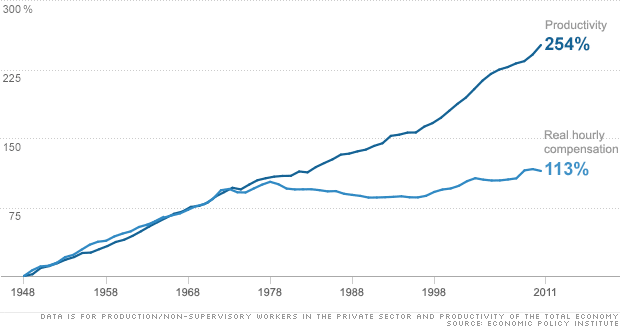
Problem:  Far from falling, total cost of employment has been rising, sharply.  Corporations have NOT been saving money by squeezing labor.  The "productivity wedge" that everybody whines about (see below) is real enough.  But it is due to our inability to come up with a sensible health care policy, and regulatory accounting rules that give substantial disincentives for hiring full time.


chart productivity hourly compensation


What is squeezing labor is enormous costs for medical care, pensions for older workers, and regulations that make hiring workers prohibitively expensive. You say workers are not getting pay increases? That's true. But those evil corporations are getting labor cost improvements, either.


For some reason, people ignore the second graph.  It is expensive, and getting more expensive, to hire workers.  The first graph simply assumes that all the "extra" profit from productivity gains is going to corporations.  But it's not true.  You can look it up.

Monday, October 14, 2013

Nobel Shout Out

So, the "Sveriges Riksbank Prize in Economic Sciences in Memory of Alfred Nobel 2013" prize has been awarded.  The Bloomberg version.

I have met Hansen, don't know Shiller personally, and know Gene Fama pretty well.   And I am (as they say here in the South) tickled at this result.  In the early 1980s, I discovered Fama's work, and spent about five years reading it all.  I have kept up a little bit since, and I think the combination of insight, elegance, and empirical connection is just unparalleled.

Here, for example, Gene has a series of papers that completely changed the way I thought (and think) about non-profits.  Non-profits are NOT "non-profit," they just happen not to be equity-financed.  That has implications for the way they behave, what their goals are, etc.  But it does not make them immune from incentives.  Check it out:
  • Eugene Fama, "Agency Problems and the Theory of the Firm," Journal of Political Economy (April 1980). 
  • Eugene Fama and Michael Jensen. "Separation of Ownership and Control", Journal of Law and Economics (June 1983). 
  • Eugene Fama and Michael Jensen. "Agency Problems and Residual Claims", Journal of Law and Economics (June 1983).  
(you may want to tack on Michael C. Jensen and William H. Meckling (1976). “Theory of the Firm: Managerial Behavior, Agency Costs, and Ownership Structure.” Journal of Financial Economics , to be fair).
 
Now, this is not a representative sample, by any means.  It is just where I came in, a self-contained little set of insights.  If you read those four papers, you will be a lot smarter.

I should add, I suppose, that Gene has been quite helpful in pointing out errors when he encounters them.  Pretty often, after I do an "EconTalk" episode, Gene will send an email that lists errors, factual or logical, that I have committed.  And he is, so far at least, always correct.

Congrats to Gene!


Tuesday, September 03, 2013

Career Advice from Tyler Cowen:

LeBron says, study this!


Looks like 8 dissertations there at least.

Looks like all will be revealed on September 12th.

Hat tip to Tim Harford.


Sunday, September 01, 2013

Pick your poison

From the inimitable Zach Weiner:


"Microeconomics successfully describes situations that never occur. Macroeconomics unsuccessfully describes situations that occur constantly."

Or as I like to tell my students, Micro has right answers to the wrong questions, while Macro has wrong answers to the right questions.

To me, this makes Macro the obvious choice of best field. But maybe that's wrong?

Friday, June 21, 2013

You can call me Al

There's an old joke, what do you call someone who graduated last in his class at Med School?.....Doctor!

Now we can add, what do you call someone who graduated in the middle of his PhD. class in Econ at Harvard 6 years ago?.......I don't know, but it's not Associate Professor.

Interesting short paper from Vanderbilt on class ranking and publishing productivity at top grad schools.

Here's the abstract:

We study the research productivity of top Ph.D. programs in economics. We find that class rank is as important as departmental rank as predictors of future research productivity. For example, the best graduate from UIUC or Toronto in a given year will have roughly the same number of American Economic Review (AER) equivalent publications at year six after graduation as the number three graduate from Berkeley, U. Penn or Yale. We also find that research productivity of graduates drops off very quickly with class rank at all departments. For example, even at Harvard, the median graduate has only 0.04 AER paper at year six, an untenurable record at almost any department. These results provide guidance on how much weight to give to place of graduation relative to class standing when hiring new assistant professors. They also suggest that even the top departments are not doing a very good job of training students to be successful research economists for any not in the top of their class.

That's right, the median Harvard Grad has 0.04 AER equivalent papers at tenure time! Ouch.

Do departments concentrate all their resources on the top few students?

Is the talent pool in economics very shallow and schools are taking students who shouldn't be there just to fill up their TA slots?


Tuesday, April 16, 2013

Thursday, February 21, 2013

Why The World Needs Economists

Fact:  Productivity (output per person/hour) is much (MUCH) higher on smaller plots of land.* 

Resolved:  That this proves that "smallholders can feed the world."  More important, large farms are wasteful, and should be broken up.

Now, my good friend Marc Bellamare is no right wing, free market fundamentalist.  But he puts the hammer down on this argument.   In fact, he puts three different hammers down on it.  Bang, bang Bellamare's silver hammer made sure it was dead. 

The point is that even if you are a lefty, being trained in economics puts a pretty tight limit on how much stupid crap you can say.  We need more economists.

*This is a fact, unless it's measurement error.  Then it's not.

Monday, February 11, 2013

We Know with Great Certainty We Have the WRONG Policiies

There are some problems with economists.  They don't often know the right thing to do.

But we are actually pretty good about recognizing the wrong thing to do.  The problem is that policy makers are driven, in part by their own overconfidence and in part by their need to be seen as "doing SOMETHING," to do things that are clearly wrong.

Great video.  Check out John Cochrane, just after 3:45 mark.  Nicely done, Dr. Cochrane.


Nod to WH.

Thursday, December 27, 2012

Economics: Older Authors, More Original Data

Six Decades of Top Economics Publishing: Who and How?

Daniel Hamermesh
NBER Working Paper, December 2012

Abstract: Presenting data on all full-length articles published in the three top general economics journals for one year in each of the 1960s through 2010s, I analyze how patterns of co-authorship, age structure and methodology have changed, and what the possible causes of these changes may have been. The entire distribution of number of authors has shifted steadily rightward. In the last two decades the fraction of older authors has almost quadrupled. The top journals are now publishing many fewer papers that represent pure theory, regardless of sub-field, somewhat less empirical work based on publicly available data sets, and many more empirical studies based on data assembled for the study by the author(s) or on laboratory or field experiments.


I wonder if this is because the revolution in economics methods changed publication in the 1950s.  Or was it just the new emphasis on publication, at all, that has now reached steady state?  If that's true, then the new distribution is what we should expect, and the bias toward younger authors and low-hanging fruit data sets was short-lived.

Nod to Kevin Lewis

Tuesday, November 20, 2012

Saturday, November 03, 2012

Scarcity is the Problem. Price Rationing is One Answer


So, I've been getting quite a few incredulous, scornful, and even insulting emails from folks who object to the idea that prices should be allowed to rise to "solve" the gas problems in the northeastern U.S.  The majority of my argument has been to claim that price will (1) induce people to buy less, thereby leaving some for everyone else, instead of the first few people in line getting all of it at an artificially low price; and (2) induce other people to find ways to supply more, by  renting generators and rushing gas to the stricken area.

Obviously, I think this argument is persuasive, and even sufficient.

Suppose, though, that you aren't convinced.  And a lot of you aren't convinced (I'm thinking of YOU, Hutter!)  Let's do this your way.

More after the jump...

Monday, October 15, 2012

Roth and Shapley Win Nobel in Econ

Alvin Roth and Lloyd Shapley win Nobel in economics for algorithms for matching.

Everything I know about this subfield I learned from my friend Atila A., here at Duke.  Here is a paper he coauthored with Roth, in the AER.  It's an interesting and important problem, though the "solutions" are highly technical.  But this paper is quite accessible.


Thursday, September 13, 2012

Soft Ball

Proprioception and Person Perception: Politicians and Professors

Michael Slepian, Nicholas Rule & Nalini Ambady
Personality and Social Psychology Bulletin, forthcoming

Abstract: Social-categorical knowledge is partially grounded in proprioception. In Study 1, participants describing "hard" and "soft" politicians, and "hard" and "soft" scientists used different "hard" and "soft" traits for the two groups, suggesting that the meaning of these traits is context specific. Studies 2 to 4 showed that both meanings were supported by hard and soft proprioception. Consistent with political stereotypes, perceivers viewing faces while handling a hard ball were more likely to categorize them as Republicans rather than as Democrats, compared to perceivers viewing the same faces while handling a soft ball (Study 2). Similarly, consistent with stereotypes of "hard" and "soft" academic disciplines, perceivers were more likely to categorize photographs of professors as physicists than historians when handling a hard versus soft ball (Study 3). Finally, thinking about Republicans and Democrats led participants to perceive a ball as harder or softer, respectively, suggesting that simulating proprioception might aid social-categorical thinking (Study 4).


With thanks to Kevin Lewis.

For some reason, that article reminds me of "The Caine Mutiny"....  (after the jump)

Thursday, June 28, 2012

What the Fudge?

Ran into an interesting journal business model this week. The American Journal of Agricultural Economics charges a page fee for accepted manuscripts. Not a submission fee for all manuscripts. Not an excess page charge for articles longer than some set limit.

Here's what their webpage says (way down at the bottom of "instructions to authors)":

"Major support for this journal comes from page charges of $40 per printed page for papers published, or a fraction thereof payable by the supporting institution or granting agency."

So a 20 journal page article will set you back $800. Weird but probably do-able.

But here's what their letter a couple days ago to Mrs. Angus said:

"Please be aware that AJAE levies page charges for accepted manuscripts in the amount of $95 per published page, and you should apprise any co-authors of your joint responsibility for this obligation in the event that your manuscript is accepted."

 That's $1900 for a 20 page paper.

People, that is some serious jack.

For those of you wondering why Mrs. Angus has any truck with the AJAE, she was working with a grad student from Ghana who was interested in tropical agriculture and they ended up with a joint paper. It cited a lot of AJAE pieces, so there it went (without them having read the fine print on the website, let alone them guessing the > 100% increase in fees the journal has levied).

If you were running a journal and wanted to use your fee structures to maximize the average quality of a submission, what would you do?

Is average quality of submission even the correct maximand? If not, what is?