Showing posts with label P-Kroog. Show all posts

Wednesday, May 07, 2014

G. Rossman Peeks at P-Kroog's Journal

And we all benefit, by getting to read it.

Excerpt:

Krugman’s Journal. May 1, 2014. Dog carcass in alley this morning. Only I predicted its stomach would burst like a housing bubble. 

 When the storm comes the insufficient aggregate demand of all their austerity will foam up about their waists and all the oligarchs and politicians will look up and shout “save us!” and I’ll look down and whisper “stimulus.” 

 (You'll need to have read "The Watchmen" to get many of the allusions.  But it works pretty well on its own!)

Wednesday, October 09, 2013

P-Kroog, the Pot, and the Kettle

John Cochrane on prediction, and the slugfest.

A slug in the slugfest.

It would be nice if P-Kroog would write about economics.  He certainly knows very little about whatever it is that he is writing about now.

Nod to Gerardo

Sunday, September 01, 2013

Broken Window

On Monday I taught this in my "Econ for Non-Majors" class (syllabus here, if you are interested...)

And used this very fine video, from the Dub-MOE.

A student noticed this, as he was walking out.  It was parked just outside the classroom.  Click for an even more deadweight loss image...

Apparently Krugman and his boys are trying to go around creating prosperity again....  After all, he proposed this.

Wednesday, March 27, 2013

Krugman Finally Jumps the Shark

I have for some time offered a defense of P-kroog. 

A tepid defense, to be sure.  But the defense has been that he had not sacrificed his intellect to his ideology in the area of international trade.  Sure, he sold out and lied about domestic macro policy, but okay:  he was still sensible on his open economy macro claims.  In fact, really impressive.  (For an example, read this.   That's great stuff.  P-kroog vintage 1993).  P-kroog, on trade, still had some sense of being required to use actual logic and evidence.

Until....now.  P-kroog has decided that the reason that investors are trying to get their money out of Greece, Cyprus, and etc. is that (wait for it) the INVESTORS are bad people, and need to be controlled.  Here it is.

There is a reason why capital mobility is one of the Mundell-Fleming "unholy trinity," along with a currency peg and an independent monetary policy.  That reason is simple:  if a country wants to impose capital controls, it can only be because they want to do something appallingly stupid to their exchange rate or their monetary policy.  Some commentary from FEE.

(I should note that the "Krugman thinks he is Pharaoh" comparison makes sense.  He won't let the capital go, he thinks he is a living god, and he lives in a city near denial, or the Nile, or something like that)

Friday, December 28, 2012

No real change in GDP, but we both ate s**t

Keynes and Krugman are walking down the street and see dog droppings.

Keynes says to Krugman: "I'll pay you $20,000 to eat those."

Krugman thinks about it, decides he really wants a ...new car, and eats the droppings.

They continue walking, then Krugman sees some other dog's droppings up ahead and says to Keynes: "Same deal: I'll pay you $20,000 to eat that."

Keynes didn't expect Krugman to take him up on his bet earlier, and he really needs the money, so he agrees.

Then Krugman says to Keynes: "We both have the same amount of money as before, but we both ate a lot of s**t."

Keynes replies: "Yeah, but there was $40,000 in stimulus to the national GDP."

Nod to Sid K.

Friday, December 14, 2012

P-Kroog on the Death of the Republican Party

P-Kroog in the NYT...

He makes two points.  One is that we are NOT having a debt crisis.  And he's clearly right,
in an unimportant way.  It's important to keep track of a distinction.  If I open a line of credit with a banker, then I get (say) $250k of "credit."   Then, I borrow $50k.  Compare me to someone else who has only borrowed $20k.  Who has more of a debt crisis?  It depends on the remaining credit of the other guy.  If he has a credit line of $20k, and he has borrowed ALL of it, then he has a debt crisis.  I have borrowed far more, $50k, but my credit is still fine, because lenders believe that I have a capacity to repay even more.

The amount of CREDIT the US has with the world is much, much bigger than the amount we have borrowed.  So, no one is seriously worried about us repaying.  Because a company that is bankrupt has no way of getting more revenues.  But the US could easily collect enough revenues to service its debt, just by raising taxes by 20%.  I think PK is underestimating the temporary effects of the Eurozone crisis, and our borrowing costs are artificially low because people just want to hold dollars and get out of Euros.  So the reason people are buying T-bonds is NOT because they are US debt, but rather because they are US dollars.  Still and all, sure, he's right about that.  I worry that we are going to raise taxes in the future to pay for stupid spending now, but there is no "Crisis".

As for the Republicans, his second point....gosh, I hope so!

Sunday, November 06, 2011

P-Kroog's new prescription for growth: Whimsy-Cal!

Military spending does create jobs when the economy is depressed. Indeed, much of the evidence that Keynesian economics works comes from tracking the effects of past military buildups. Some liberals dislike this conclusion, but economics isn’t a morality play: spending on things you don’t like is still spending, and more spending would create more jobs. But why would anyone prefer spending on destruction to spending on construction, prefer building weapons to building bridges? John Maynard Keynes himself offered a partial answer 75 years ago, when he noted a curious 'preference for wholly ‘wasteful’ forms of loan expenditure rather than for partly wasteful forms, which, because they are not wholly wasteful, tend to be judged on strict ‘business’ principles.' Indeed. Spend money on some useful goal, like the promotion of new energy sources, and people start screaming, 'Solyndra! Waste!' Spend money on a weapons system we don’t need, and those voices are silent, because nobody expects F-22s to be a good business proposition. To deal with this preference, Keynes whimsically suggested burying bottles full of cash in disused mines and letting the private sector dig them back up. In the same vein, I recently suggested that a fake threat of alien invasion, requiring vast anti-alien spending, might be just the thing to get the economy moving again. NYTimes

So, all you lefty bedwetters who wanted to defend Krugman as being "not serious" about the alien invasion thing...what now? I guess you have a new answer: Krugman was NOT serious, but he had overdosed on that new Keynesian diet supplement: "Whimsy-Cal!"

The alternative is that we need GW Bush back in office. Right? Elective wars are good for the U.S. and good for the digestive system. Or was that madcap P-Kroog just being "Whimsy-Cal" again?

UPDATE: Some pretty good reasons why this "Whimsy-Cal" thing is pretty dangerous.

Tuesday, October 18, 2011

Monday, October 10, 2011

P-Kroog!

Always the critic, always with the details...P-kroog objects to this graph.

Some background on the upward sloping aggregate demand argument. Proving once again that P-kroog is just not that good a macro-economist. ("Minsky moment?" Have Angus draw you his famous "Minsky curve" sometime. It's downward drooping.)

Nod to Kevin Lewis

Sunday, September 11, 2011

Fixing Social Security: Opposite Day

Had a rather spirited discussion with a friend, with him taking the side that Gov. Perry was out of line calling Soc Sec a "Ponzi scheme." And with me being loudly incredulous that anyone could think Soc Sec is anything OTHER than a Ponzi scheme.

A-Tab is sensible, but confirms the thing is a Ponzi scheme.

Both of the St. Pauls (Samuelson and Krugman), dear to the left, call it a Ponzi scheme.

But, on reflection, I agree with the view here. Soc Sec is not a Ponzi scheme, because it is much, much worse than a Ponzi scheme. Even if you take the Mother Jones view on this (and I rarely quote from Mother Jones, for some reason), it 's pretty clear:

...the real problem with Dalmia's description is the notion that Social Security collects money from new investors and uses it to pay off previous investors. It's easy enough to see why people believe this: it was, basically, the way the program was initially sold. And politicians ever since have found it convenient to continue this fiction. Seniors today are all convinced that the money they paid into the program during their working years was somehow saved up for them and now they're getting it back.

But that's always been a lie. Social Security is actually a much simpler program than that. I'm going to put the rest of this paragraph in bold so you can't possibly miss it. Here's how Social Security works: every month we take in taxes from working people and every month we turn around and distribute those taxes to retirees. That's it. That's how it works, and everyone who actually knows anything about the program knows that's how it works. Taxes come in, benefits go out.
(Emphasis in bright blood letters mine, not in original; bold emphasis was in original)

Did you get that? Soc Sec is a lie, a fraud. And that's Mother Jones, well-known branch of Fox News. Not.

Some definitions: A Ponzi scheme
(1) depends on a constantly increasing membership to pay benefits or validate excessive returns to the older member, and
(2) is unsustainable at some point, in the sense that payments exceed revenues by increasing amounts, meaning that new members are needed, and
(3) those new members have to be recruited either through fraud or force, since informed and autonomous new members know that they have little hope of being paid back.

This could be
(A) because the older members get greedy, and take larger and larger amounts out of the system, or
(B) because the number of new members entering the system is not sufficient to pay the benefits already promised.

Some points:
* Mitchell Zuckoff, quoted here, claims “Ponzi schemes are, by definition, fraud.” He may be wrong about other things, too, but he is clearly wrong about this. First of all, Soc Sec is in fact a fraud, as our Mother Jones correspondent ably exegeted. Second, even if people KNOW that the system is unsustainable, the system is Ponzi, because it is an intentionally created bubble. All that is necessary is conditions (1) and (2), NOT fraud. People trade in bubbles long after they know the underlying assets have no real value, as Charles Plott and Vernon Smith have showed. Third, even if the bubble has burst, fraud is not required as long as force is an option. And force is worse than fraud, unless you are a leftist and think you are just forcing other idiots to be free. I have to ask: Does Mr. Zuckoff seriously believe that young people would voluntarily sign up for Soc Sec, if they had an option? Look, fraud means you get screwed unexpectedly. Force means we all tell you young folks you are going to get screwed, and then we screw you, good and hard. At least it's not fraud, right? (Here, again, Mr. Zuckoff asserts Ponzi schemes have to be fraudulent. My claim is that he's wrong; all they have to be is involuntary. Either fraud or choice under duress, which have equal standing as violation of common law contract agreements, are enough to make a scheme Ponzi.)

* And the "It's not a Ponzi, because it can be fixed" argument? It can only be fixed if we kidnap, and then take more money at gunpoint from, "investors." Charles Ponzi's scheme failed because he didn't have tanks. Our President has tanks, and can force new "investors" to pony up. If THAT is your defense of why Soc Sec is not Ponzi, you need to go rethink some basic assumptions about "investement." Being forced to invest at gunpoint is theft. And that's worse than anything Mr. Ponzi could have done. The only reason that Soc Sec is not fraud is that people have no choice about contributing. If it were voluntary, then fraud would be required to get them to sign up. Sure, we can fix this, but only by using force.

* Finally, my friend told me, "Soc Sec is not a Ponzi scheme, because it has served millions of people with income." Dude! Any successful Ponzi scheme, by definition, serves the people who get in early. In fact, most Ponzi schemes serve the first movers much BETTER than Soc Sec has served retirees. The problem with Ponzis is not what happens to the first in, but rather the raping received by the last in. The only reason Soc Sec is working is that Soc Sec REQUIRES young people to become new investors. Again, if Charles Ponzi had been able to recruit by garnishing wages with "payroll taxes," that first Ponzi scheme might still be running along just fine.

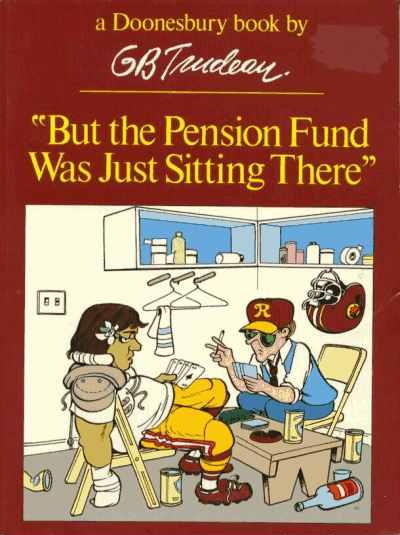
Stepping back: I admit that originally, Soc Sec was not a Ponzi scheme, by my definition. But then Congress realized that there was a huge Baby Boom bubble, and created the Trust Fund. And THEN Congress realized that while one could not get reelected by doing the right thing and leaving the Trust Fund alone, one certainly COULD get reelected by looting the Trust Fund now and giving much larger benefits, especially in the Disability and Supplemental categories. (As Coach Duke said, "The pension fund was just sitting there!")

So, when the Baby Boom bulge in retirements happened, Soc Sec became a Ponzi scheme. The benefits were much too large, the Trust Fund was actually debt, not assets, in a period of large deficits. And we don't have nearly enough new people entering the system to keep you fat ass 'Boomers in scones and lattes.

Now, our President, who seems to think every day is "Opposite Day," proposes to solve the Soc Sec problem and the unemployment problem by... by... (I can't say it)... cutting the taxes that finance Soc Sec. Not, mind you, as part of an overall plan with offsetting cuts to make Soc Sec NOT a Ponzi scheme.

Now it will be a Ponzi scheme on stilts, with gold plating.

Except, as SD at Reason notes, this Ponzi scheme will not collapse. Instead, men with guns will find some way to finance it. Deficits are future taxes.

A photo of our plan to fix Soc Sec (it's a metaphor; a "deep" metaphor)

Wednesday, August 17, 2011

Stopped Clock-onomics

"[J]ust to be clear, there's nothing wrong with a low cost of living. In particular, there's a good case to be made that zoning policies in many states unnecessarily restrict the supply of housing, and that this is one area where Texas does in fact do something right."

What? WHAT? What alien spaceship stole P-Kroog, and who is this guy?

I think the problem is P-Kroog is actually a first-rate economist, and so sometimes he forgets his self-appointed role as slinger of shinola and actually makes sense briefly.

That article, linked above, does pretty quickly revert to P-Kroogery of the worst sort. But, for just a minute there....

It's Different if SPACE ALIENS Break the Window

The broken window fallacy is pernicious. John Stossel explains, for those of you who have lived under a rock, or studied economics at Harvard, MIT, or Princeton.

(heh; heh heh; heh: he said, "Fallacious")

Most recently, of course, it was KPC's favorite deep space Keynesian, P-Kroog.

Mary Theroux has some thoughts.


...

Tuesday, May 10, 2011

The Most Pompous Man on Earth

Okay, so P-Kroog is the most pompous, least self-aware, most earnestly immune from self-doubt person in journalism today. (Olbermann is a bigger a-hole, but he has some ironic self-awareness).

Still, I refuse to believe that this P-Kroog critique of how elites misled policy, and blamed voters, is anything but satire. Surely even P-Kroog had to recognize that he is really talking about himself.

Well, what I’ve been hearing with growing frequency from members of the policy elite — self-appointed wise men, officials, and pundits in good standing — is the claim that it’s mostly the public’s fault. The idea is that we got into this mess because voters wanted something for nothing, and weak-minded politicians catered to the electorate’s foolishness.

So this seems like a good time to point out that this blame-the-public view isn’t just self-serving, it’s dead wrong.

The fact is that what we’re experiencing right now is a top-down disaster. The policies that got us into this mess weren’t responses to public demand. They were, with few exceptions, policies championed by small groups of influential people — in many cases, the same people now lecturing the rest of us on the need to get serious. And by trying to shift the blame to the general populace, elites are ducking some much-needed reflection on their own catastrophic mistakes.


He's got to realize that's irony, right? He's GOT to.

(Nod to Angry Alex)

Friday, April 29, 2011

Not So Fast, II

So, a schmuck in the audience tries to make the Krugman point, and cites Krugman as an authority. Hilarity ensues.

P-Kroog is a punch line, a clown. And it is not because he is dumb; far from it. He is completely unconstrained by facts or logic. I think P-Kroog actually believes he has evolved into pure energy, and need no longer worry about petty things.

(Nod to Leonard S)

Monday, October 25, 2010

Fisk, Fisk, Fisk

P-Kroog is well beyond self-caricature. He has become the Michael Jackson of economists. You want to look away, but you. just. can't.

Nod to Angry Alex

Monday, August 16, 2010

P-Kroog Gets Schooled

Cato's Alan Reynolds reams P-Kroog a new one.

To get called on such obvious sophomore undergrad mistakes....well, P-Kroog would be embarrassed, if he had not long ago sold his soul to the goddess Fame.