JMPP transforms a silly mistake into performance art.
She went to class, thinking classes started on MONDAY after break. But, of course, lots of kids aren't done throwig up yet. Classes don't start until Tuesday.
Does she panic? She does not; she blogs about it on the spot. Blogs can turn embarrassing mistakes into performance art. And they can help with those dry patches on your elbows.
Thinking of the early thing: My first teaching job was at Dartmouth, in the Econ Department. The chairman and his wife were having a party at their house. I got all dressed up (meaning i wore socks, and freshly laundered wrestling spandex), and went to the chairman's house. He was mowing the lawn; not a good sign.
But I figured he was running late, and I was five minutes early. It turns out I was five minutes plus a WEEK early.
He was so embarrassed for me (he was very old school) that he shut off the mower and invited me inside. We sat at his kitchen table and had lemonade. He had these great old chairs, antiques. I leaned back in one, and it immediately broke into about 100 small pieces. I took one piece of shrapnel/splinter in the bottom, and he helped me remove it. He refused any payment for the chair.
A week later, I was too embarrassed to go to the real party.
If I could have blogged about it, I would have felt better.
I feel better now.
Tuesday, March 29, 2005


Monday, March 28, 2005
Now I'm Confused
The Schiavo case is NOT just a minor curiousity.
It is revealing splits in the right/libertarian coalition.
My canary in the coal mine is the very clever, and (I thought) solidly libertarian William Sjostrom.
The point is that I have great respect for his views. If he is this angry, or this angry, then I really am missing something.
Things I could be missing:
1. There is a conspiracy among doctors to misrepresent the mentally long-dead Terry's condition. Their motive is....I have no idea.
2. Freedom-loving people should want the government to waste lots of time on person-specific, ex post facto laws substituting emotionally hysterical mob rule for the established rights of next-of-kin to control the manner of living, and if necessary of dying, for their loved ones. The reason is....I can't imagine.
3. If I was brain dead, and had been for years, as a result of a failed suicide attempt, I would want people to prolong my misery, allowing me to be a huge burden both financially and emotionally, for as long as possible. The reason is...remind me, why did I want to go on living in a ghoulish, nonsentient suspended animation, exactly?
In short, I may just be projecting. The doctors who say she is brain dead, I believe. The people who say that government should intrude, using its coercive powers in the service of craven politics, I don't believe. And I beg anyone who will listen to fucking SHOOT ME if I ever end up like that.
It is revealing splits in the right/libertarian coalition.
My canary in the coal mine is the very clever, and (I thought) solidly libertarian William Sjostrom.
The point is that I have great respect for his views. If he is this angry, or this angry, then I really am missing something.
Things I could be missing:
1. There is a conspiracy among doctors to misrepresent the mentally long-dead Terry's condition. Their motive is....I have no idea.
2. Freedom-loving people should want the government to waste lots of time on person-specific, ex post facto laws substituting emotionally hysterical mob rule for the established rights of next-of-kin to control the manner of living, and if necessary of dying, for their loved ones. The reason is....I can't imagine.
3. If I was brain dead, and had been for years, as a result of a failed suicide attempt, I would want people to prolong my misery, allowing me to be a huge burden both financially and emotionally, for as long as possible. The reason is...remind me, why did I want to go on living in a ghoulish, nonsentient suspended animation, exactly?
In short, I may just be projecting. The doctors who say she is brain dead, I believe. The people who say that government should intrude, using its coercive powers in the service of craven politics, I don't believe. And I beg anyone who will listen to fucking SHOOT ME if I ever end up like that.
Sunday, March 27, 2005
Robbed, I bin ROBBED!
Wow. Turns out that people charge different prices to cut hair, with women paying more. Call Larry Summers: either women are not bright enough to open their own hair care salons, and compete the price differential down to zero, or else there is SOMETHING DIFFERENT about men and women in terms of the level of quality and service they expect in haircuts.
Here is an excerpt from the exciting expose:
When the haircutters who charged women more than men for a basic haircut were asked why a price disparity existed between men's and women's identical services, the following responses were given--25% stated that a combination of hair length, extra time, and hairstyles were the reasons...22% attributed the length of a woman's hair...11 % stated that the extra time spent on women's hair was the main reason...9% said that women's hairstyles and the complexity of some of them were the reasons...15% replied that that's the way the prices are set or that the owners sets the prices...12% said that they did not know why women were charged more than men. The remaining 6% either hung up, said it depended on which hairdresser cut the hair, didn't want to speak about it, said that the price was a special, or said that the prices were set ". . .because a man is a man and a woman is a woman. "
These responses suggest that many haircutting establishments rely on gender-based stereotyping in setting prices for basic and comparable services. Despite the fact that Council staff informed the haircutters that both the caller and her, his boy/girlfiiend had the same length hair, these haircutters did not appear to factor this into consideration when quoting a price.
ATSRTWT.
Now, those of you who have had the great pleasure of beholding Kgrease in the flesh know that (1) there is a lot of flesh, and (2) my hair is shoulder length, very curly, and with lots of blonde highlights. Some of those highlights are from the sun, but most come from chemical products applied by a trained and highly competent hairdresser. (That's right: "My name is Blonde....Fake Blonde.")
A wash/haircut/highlights job from my hairdresser costs $90, plus $15 or so tip. Turns out that is the same price my lady charges women for the "same" work.
So....I have been ripped off! I should have been charged less, 'cause I am a guy. Next time I get a 'do I'm going to drop trou and show her Mr. Winky, and demand a refund. (She might give me the money, too, out of amusement, or pity for my wife).
You might want to look at this, by Russ Roberts. He says his kids are wary. Mine are, too. Hard to have an econophile for a dad.
(Nod to RF, who wrote this)
Here is an excerpt from the exciting expose:
When the haircutters who charged women more than men for a basic haircut were asked why a price disparity existed between men's and women's identical services, the following responses were given--25% stated that a combination of hair length, extra time, and hairstyles were the reasons...22% attributed the length of a woman's hair...11 % stated that the extra time spent on women's hair was the main reason...9% said that women's hairstyles and the complexity of some of them were the reasons...15% replied that that's the way the prices are set or that the owners sets the prices...12% said that they did not know why women were charged more than men. The remaining 6% either hung up, said it depended on which hairdresser cut the hair, didn't want to speak about it, said that the price was a special, or said that the prices were set ". . .because a man is a man and a woman is a woman. "
These responses suggest that many haircutting establishments rely on gender-based stereotyping in setting prices for basic and comparable services. Despite the fact that Council staff informed the haircutters that both the caller and her, his boy/girlfiiend had the same length hair, these haircutters did not appear to factor this into consideration when quoting a price.
ATSRTWT.
Now, those of you who have had the great pleasure of beholding Kgrease in the flesh know that (1) there is a lot of flesh, and (2) my hair is shoulder length, very curly, and with lots of blonde highlights. Some of those highlights are from the sun, but most come from chemical products applied by a trained and highly competent hairdresser. (That's right: "My name is Blonde....Fake Blonde.")
A wash/haircut/highlights job from my hairdresser costs $90, plus $15 or so tip. Turns out that is the same price my lady charges women for the "same" work.
So....I have been ripped off! I should have been charged less, 'cause I am a guy. Next time I get a 'do I'm going to drop trou and show her Mr. Winky, and demand a refund. (She might give me the money, too, out of amusement, or pity for my wife).
You might want to look at this, by Russ Roberts. He says his kids are wary. Mine are, too. Hard to have an econophile for a dad.
(Nod to RF, who wrote this)
Saturday, March 26, 2005
I Must Just Be Inert...
...cause I cannot work myself into a fevered, irrational fury for either side in l'affaire Schiavo. It is tragic, all of it. Why is it a matter of national policy? Why is the state (both the FLA state and the FED state) butting in?
I think that two of the best things I have seen are these:
I started the week off thinking that Congress and the President did a good thing by allowing the federal courts to have a look at this. In the mean time it has become clear that the other supporters of that decision won’t be happy until they get the right outcome, regardless of what the law says. Every time a decision that goes against them is made, they move the goalposts and no-one will be spared from their wrath. I hope the Republicans (and I, also) never fall for an attempt to pander to hysterics again.
ATSRTWT
and this:
In all the debate about "what Terri would have wanted" people seem to be forgetting that her vegetative state was initially caused by anorexia and bulimia. She was TRYING to starve herself. Let her finish.
ATSRTWT
(Nod to CL, who said this the Schiavo controversy:
the libertarian in me thinks (perhaps on the erroneous assumption that time is a meaningful legislative commodity) the more time they spend on this the less they can spend futzing with my life. )
I think that two of the best things I have seen are these:
I started the week off thinking that Congress and the President did a good thing by allowing the federal courts to have a look at this. In the mean time it has become clear that the other supporters of that decision won’t be happy until they get the right outcome, regardless of what the law says. Every time a decision that goes against them is made, they move the goalposts and no-one will be spared from their wrath. I hope the Republicans (and I, also) never fall for an attempt to pander to hysterics again.
ATSRTWT
and this:
In all the debate about "what Terri would have wanted" people seem to be forgetting that her vegetative state was initially caused by anorexia and bulimia. She was TRYING to starve herself. Let her finish.
ATSRTWT
(Nod to CL, who said this the Schiavo controversy:
the libertarian in me thinks (perhaps on the erroneous assumption that time is a meaningful legislative commodity) the more time they spend on this the less they can spend futzing with my life. )
Friday, March 18, 2005
Pooling Resources
In my book, ANALYZING POLICY, I have a chapter on politics and voting.
In it, there is an example of municipal pool. 5 citizens, 3 want a pool and 2 don't. Now, the 3 citizens could form a private club (Thanks, Professor James B!), and build their own club (pools are excludable, no need for them to be "public" in any sense).
But the 3 citizens can force their will on the other 2, and make the pool collective. Not public (pools are excludable, at low cost. Have to have a fence, anyway, to keep little kids and goats out) but collective. That way, the 3 citizens who want a pool can steal the "support" (meaning money, taken against their will and at gunpoint) from the other 2 citizens. As usual, democracy is 3 wolves and 2 sheep deciding what's for lunch (feeling sheepish?)
Anyway....the Onion has this excellent satire. Excerpt:
MANKATO, MN—The Mankato City Council voted 6-3 against the issuance of a $500,000 municipal bond Tuesday, marking the end of one man's tireless, 10-year-long crusade to ensure that a proposed community pool not be built.
"Victory!" said Irv Draper, founder of Taxpayers For Wise Choices, who announced the bond's defeat from the steps of City Hall. "Today, the city council stood up in favor of the long-term interests of tax-paying Mankatoans. After 10 long years of ceaseless toil, I can finally say that a swimming pool will not be built!"
Compare that with this excerpt from my chapter 6:
Suppose that five citizens of tiny Ruttenton have met for their annual town meeting. This body is empowered to make decisions for the entire town, and all citizens have agreed in advance to abide by the collective decision. Notice that this doesn’t mean that the citizens expect to agree on all policies. Instead, the citizens (Mr. One, Ms. Two, Ms. Three, Mr. Four, and of course the mayor, Mr. Fish) all have pledged in advance to accept the collective decision.
At a previous meeting, the five citizens agreed unanimously that decisions will be made by majority rule: if three of the five citizens favor one alternative, that alternative will become Ruttenton law. Each citizen can make any proposal they care to introduce, but the time for making proposals or debating motions is restricted to a total of five hours. At the end of five hours, the citizens must vote to decide on the best policy.
The meeting this year has only one agenda item: The Ruttenton Community Pool. Mayor Fish, who very much enjoys swimming, now has to travel 25 miles to the pool in Blaineville. He wants to build an enormous, Olympic size pool (expected cost: $100,000), both because it would be more convenient for him and because it would be a statement of Ruttenton civic pride (the Blainville pool is rather small). As Mayor Fish is fond of saying, “You can’t attract a new Mercedes plant without a community pool!”
Ms. Three and Mr. Four also favor building a pool, because they like to swim for recreation and occasional exercise. Three and Four only want to build a medium-size pool (expected cost: $60,000), however, thinking that an enormous pool wouldn’t be used enough to justify the expense. Furthermore, they don’t believe Mercedes is going locate a new assembly plant in the area anyway, since Ruttenton has no roads.
Mr. One and Ms. Two have no use for a pool, and vehemently oppose the proposal to build a community pool in Ruttenton. They claim that they should not have to pay for a pool if they are not going to use it, and object to Mayor Fish’s plan to finance the pool out of property taxes. One and Two argue that, if a pool is built at all, it should be run as a community “club”, with the costs of building and operation coming from membership fees and charges at the door.
(Nod to RL, who is really a libertarian)
In it, there is an example of municipal pool. 5 citizens, 3 want a pool and 2 don't. Now, the 3 citizens could form a private club (Thanks, Professor James B!), and build their own club (pools are excludable, no need for them to be "public" in any sense).
But the 3 citizens can force their will on the other 2, and make the pool collective. Not public (pools are excludable, at low cost. Have to have a fence, anyway, to keep little kids and goats out) but collective. That way, the 3 citizens who want a pool can steal the "support" (meaning money, taken against their will and at gunpoint) from the other 2 citizens. As usual, democracy is 3 wolves and 2 sheep deciding what's for lunch (feeling sheepish?)
Anyway....the Onion has this excellent satire. Excerpt:
MANKATO, MN—The Mankato City Council voted 6-3 against the issuance of a $500,000 municipal bond Tuesday, marking the end of one man's tireless, 10-year-long crusade to ensure that a proposed community pool not be built.
"Victory!" said Irv Draper, founder of Taxpayers For Wise Choices, who announced the bond's defeat from the steps of City Hall. "Today, the city council stood up in favor of the long-term interests of tax-paying Mankatoans. After 10 long years of ceaseless toil, I can finally say that a swimming pool will not be built!"
Compare that with this excerpt from my chapter 6:
Suppose that five citizens of tiny Ruttenton have met for their annual town meeting. This body is empowered to make decisions for the entire town, and all citizens have agreed in advance to abide by the collective decision. Notice that this doesn’t mean that the citizens expect to agree on all policies. Instead, the citizens (Mr. One, Ms. Two, Ms. Three, Mr. Four, and of course the mayor, Mr. Fish) all have pledged in advance to accept the collective decision.
At a previous meeting, the five citizens agreed unanimously that decisions will be made by majority rule: if three of the five citizens favor one alternative, that alternative will become Ruttenton law. Each citizen can make any proposal they care to introduce, but the time for making proposals or debating motions is restricted to a total of five hours. At the end of five hours, the citizens must vote to decide on the best policy.
The meeting this year has only one agenda item: The Ruttenton Community Pool. Mayor Fish, who very much enjoys swimming, now has to travel 25 miles to the pool in Blaineville. He wants to build an enormous, Olympic size pool (expected cost: $100,000), both because it would be more convenient for him and because it would be a statement of Ruttenton civic pride (the Blainville pool is rather small). As Mayor Fish is fond of saying, “You can’t attract a new Mercedes plant without a community pool!”
Ms. Three and Mr. Four also favor building a pool, because they like to swim for recreation and occasional exercise. Three and Four only want to build a medium-size pool (expected cost: $60,000), however, thinking that an enormous pool wouldn’t be used enough to justify the expense. Furthermore, they don’t believe Mercedes is going locate a new assembly plant in the area anyway, since Ruttenton has no roads.
Mr. One and Ms. Two have no use for a pool, and vehemently oppose the proposal to build a community pool in Ruttenton. They claim that they should not have to pay for a pool if they are not going to use it, and object to Mayor Fish’s plan to finance the pool out of property taxes. One and Two argue that, if a pool is built at all, it should be run as a community “club”, with the costs of building and operation coming from membership fees and charges at the door.
(Nod to RL, who is really a libertarian)
Thursday, March 17, 2005
Man are From Mars
News flash: Big differences between men and women. At 11: Dog bites man!
In fact, there is not one human genome, but two: the male genome and the female genome.
I know we all claim to believe size doesn't matter, but the X chromosome is a lot more complex than the stunted, shriveled little Y chromosome.
My Duke colleague, Huntington Willard, can apparently never be Prez of Harvard. Too many of those bothersome scientific questions, that might have answers, instead of the theology self-important emotion.
In fact, there is not one human genome, but two: the male genome and the female genome.
I know we all claim to believe size doesn't matter, but the X chromosome is a lot more complex than the stunted, shriveled little Y chromosome.
My Duke colleague, Huntington Willard, can apparently never be Prez of Harvard. Too many of those bothersome scientific questions, that might have answers, instead of the theology self-important emotion.
3 links, no relation
First: on blogging. A charming simplicity, but a bunch of stuff I wish I had known. Not like I'm an expert now, except in surrealism.
Second, this headline didn't make sense to me: US TROOPS SHOOT DEAD IRAQI GENERAL. If he was dead, why did they shoot him? But it turns out that we just screwed up again. Perhaps the troops thought the general was an Italian communist ex-hostage journalist, and they shoot those on sight? Seriously, what do the conspiracy theorists think about this shooting of a general? Why not just accept the fog-of-war, scared-kids-in-combat, and-it-was-dark, thesis? The claims about the Italian journalist are bizarre.
Third: patterned after Jeff Foxworthy ("if...you might be a redneck"), we get "You know it's a dictatorship". (Nod to Betsy)
Second, this headline didn't make sense to me: US TROOPS SHOOT DEAD IRAQI GENERAL. If he was dead, why did they shoot him? But it turns out that we just screwed up again. Perhaps the troops thought the general was an Italian communist ex-hostage journalist, and they shoot those on sight? Seriously, what do the conspiracy theorists think about this shooting of a general? Why not just accept the fog-of-war, scared-kids-in-combat, and-it-was-dark, thesis? The claims about the Italian journalist are bizarre.
Third: patterned after Jeff Foxworthy ("if...you might be a redneck"), we get "You know it's a dictatorship". (Nod to Betsy)
Wednesday, March 16, 2005
What Do You Do When You're Branded?
Apparently, segun Captain's Quarters, the new buzzword for the political left-overs is "branding."
And the branding mistress is Hillary Clinton.
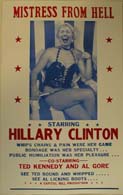
Sounds pretty fun, actually. Branding Hillary, I mean. Yee-haw.
And the branding mistress is Hillary Clinton.
Sounds pretty fun, actually. Branding Hillary, I mean. Yee-haw.
FEC: I Like to Watch
As I said a few days ago, there is a real problem here. Believing government officials are good people, and won't abuse their powers, is not what we are about.
An update from Patterico, via GR.
I try to make this point to students all the time, but most of them just don't see the difference. Here is the way to make the point, in my view: Consider
1. The U.S. First Amendment
Congress shall make no law respecting an establishment of religion, or prohibiting the free exercise thereof; or abridging the freedom of speech, or of the press; or the right of the people peaceably to assemble, and to petition the government for a redress of grievances.
Not many qualifiers, not much about trade-offs. No law.
2. Now, the analogous part of the French Dec'n of the Rights of Man
10. No one shall be disquieted on account of his opinions, including his religious views, provided their manifestation does not disturb the public order established by law.
11. The free communication of ideas and opinions is one of the most precious of the rights of man. Every citizen may, accordingly, speak, write, and print with freedom, but shall be responsible for such abuses of this freedom as shall be defined by law.
WHAAAAAAT? Opinions can't disquiet the public order established by law? I have to be responsible for abuses as shall be defined by law?
In other words, you can say or write anything you want, so long as it is not against the law. But any speech, writing or thoughts prescribed by law are not protected.
I wonder if "FEC" stands for "French Election Commission".
An update from Patterico, via GR.
I try to make this point to students all the time, but most of them just don't see the difference. Here is the way to make the point, in my view: Consider
1. The U.S. First Amendment
Congress shall make no law respecting an establishment of religion, or prohibiting the free exercise thereof; or abridging the freedom of speech, or of the press; or the right of the people peaceably to assemble, and to petition the government for a redress of grievances.
Not many qualifiers, not much about trade-offs. No law.
2. Now, the analogous part of the French Dec'n of the Rights of Man
10. No one shall be disquieted on account of his opinions, including his religious views, provided their manifestation does not disturb the public order established by law.
11. The free communication of ideas and opinions is one of the most precious of the rights of man. Every citizen may, accordingly, speak, write, and print with freedom, but shall be responsible for such abuses of this freedom as shall be defined by law.
WHAAAAAAT? Opinions can't disquiet the public order established by law? I have to be responsible for abuses as shall be defined by law?
In other words, you can say or write anything you want, so long as it is not against the law. But any speech, writing or thoughts prescribed by law are not protected.
I wonder if "FEC" stands for "French Election Commission".
Are the Congressional Republicans Bankrupt?
William Sjostrom has some interesting thoughts on the bankruptcy bill.
I have tended more to the Glenn Reynolds view, though of course Sjostrom points out this smacks of "daily Kos" style argument, than which nothing is more superficial.
Making discharge of credit card debt harder makes it more attractive to lend. Moreover, borrowers who know themselves to be high risk (call them dishonest) are driven away by customers who know themselves to be lower risk (call them honest). It is Daily Kos level analysis to try to reduce this problem to us poor little helpless consumers against the big mean corporate interests.
WS also notes:
Easy discharge of debts drives up interest rates. The gainers are the dishonest borrowers who plan to retreat into bankruptcy (why worry about the interest rate if you do not plan to pay off?). The losers are the more honest borrowers who face higher rates.
ATSRTWT.
I have tended more to the Glenn Reynolds view, though of course Sjostrom points out this smacks of "daily Kos" style argument, than which nothing is more superficial.
Making discharge of credit card debt harder makes it more attractive to lend. Moreover, borrowers who know themselves to be high risk (call them dishonest) are driven away by customers who know themselves to be lower risk (call them honest). It is Daily Kos level analysis to try to reduce this problem to us poor little helpless consumers against the big mean corporate interests.
WS also notes:
Easy discharge of debts drives up interest rates. The gainers are the dishonest borrowers who plan to retreat into bankruptcy (why worry about the interest rate if you do not plan to pay off?). The losers are the more honest borrowers who face higher rates.
ATSRTWT.
Blog for Blog's Sake: Accepting My Lott in Life
Interesting now to look back at this article from the Chron of Higher Ed, nearly two years old now.
Most people, even in the U.S., don't know what a "blog" is today. Two years ago, you had to be pretty up on things to read blogs.
Here is Crooked Timber's list of academic bloggers. It is clearly not up to date (it doesn't include Mungowitz End) but tasteful (it doesn't include Mungowitz End).
From the Chronicle article:
One of the most combative strains of scholarly blogging is the investigation of alleged academic misconduct. The work of John R. Lott Jr., a gun researcher who has been accused of inventing the results of a telephone survey out of whole cloth (a charge he denies), has persistently been scrutinized by at least six bloggers. Mr. Lott's research, in fact, is the sole topic of a blog maintained by Timothy D. Lambert, a lecturer in computer science at the University of New South Wales, in Australia. And it was another blogger, Julian Sanchez, a staff writer at the Cato Institute, who discovered and confirmed that Mr. Lott had been participating in Internet discussion groups under the name "Mary Rosh."
Well, I was just on a panel at the Public Choice meetings with John (who I have known for nearly 20 years, and who I consider a friend), and I can at least confirm that he is not DRESSING as Mary Rosh. Not that I didn't ask him to. Beg, really.
And I had never seen the Lambert blog. Good lord. The guy is a "large mammal" on the TTLB ecosystem. WTF?
UPDATE: I take it back. I spent about 45 minutes reading different part of Lambert's blog, and I can easily see why people read it, and link to it. As I said, I really do like John L, and admire his ability as a scholar. But he has made some (to say the least) questionable choices.
And, a personal anecdote. I had agreed to serve as a discussant on a panel at Public Choice, a panel John himself had organized. The papers were: Groseclose/Milyo, Lott himself, Dan Sutter, and Ricardo Puglisi. I had been going to offer comments on the G/M paper, but had prepared remarks on everything. This was an excellent panel, one of the best and most coherent at the meetings, and John Lott did all the work of organizing it. There were probably 40 people in the room, a very good turnout.
When Milyo could not come to the meeting (because he's a weasel; yes, Jeff, I said that), that meant that my primary discussant role was cut. But I had worked for a couple of hours on other things to say.
Well....what happened was that the other papers' time was expanded. Near the end, I got ready to speak. But we hadn't had time for audience questions, so I said I would wait until the audience had a chance. John Lott took up all the remaining time, giving detailed point-by-point refutations of even the tiniest remark or question. In the end, I never got to speak at all.
I don't blame John for this. He can't help it. And, to be fair, he had asked me to go ahead and take my turn earlier, so it wasn't like he didn't give me a full opportunity to speak if I wanted to. He did; he asked me to go ahead. But the audience hadn't asked questions yet.
The point is that, when there was open time in the panel, which I thought we would use for audience questions, he just had to take it himself. It's an obsession, not a choice.
I think this explains the book reviews, and Mary Rosh comments: he needs the positive response, or else he has to take as much time as there is available to rebut any negative response. Sad, really. Because he really is a good guy, and very smart.
Most people, even in the U.S., don't know what a "blog" is today. Two years ago, you had to be pretty up on things to read blogs.
Here is Crooked Timber's list of academic bloggers. It is clearly not up to date (it doesn't include Mungowitz End) but tasteful (it doesn't include Mungowitz End).
From the Chronicle article:
One of the most combative strains of scholarly blogging is the investigation of alleged academic misconduct. The work of John R. Lott Jr., a gun researcher who has been accused of inventing the results of a telephone survey out of whole cloth (a charge he denies), has persistently been scrutinized by at least six bloggers. Mr. Lott's research, in fact, is the sole topic of a blog maintained by Timothy D. Lambert, a lecturer in computer science at the University of New South Wales, in Australia. And it was another blogger, Julian Sanchez, a staff writer at the Cato Institute, who discovered and confirmed that Mr. Lott had been participating in Internet discussion groups under the name "Mary Rosh."
Well, I was just on a panel at the Public Choice meetings with John (who I have known for nearly 20 years, and who I consider a friend), and I can at least confirm that he is not DRESSING as Mary Rosh. Not that I didn't ask him to. Beg, really.
And I had never seen the Lambert blog. Good lord. The guy is a "large mammal" on the TTLB ecosystem. WTF?
UPDATE: I take it back. I spent about 45 minutes reading different part of Lambert's blog, and I can easily see why people read it, and link to it. As I said, I really do like John L, and admire his ability as a scholar. But he has made some (to say the least) questionable choices.
And, a personal anecdote. I had agreed to serve as a discussant on a panel at Public Choice, a panel John himself had organized. The papers were: Groseclose/Milyo, Lott himself, Dan Sutter, and Ricardo Puglisi. I had been going to offer comments on the G/M paper, but had prepared remarks on everything. This was an excellent panel, one of the best and most coherent at the meetings, and John Lott did all the work of organizing it. There were probably 40 people in the room, a very good turnout.
When Milyo could not come to the meeting (because he's a weasel; yes, Jeff, I said that), that meant that my primary discussant role was cut. But I had worked for a couple of hours on other things to say.
Well....what happened was that the other papers' time was expanded. Near the end, I got ready to speak. But we hadn't had time for audience questions, so I said I would wait until the audience had a chance. John Lott took up all the remaining time, giving detailed point-by-point refutations of even the tiniest remark or question. In the end, I never got to speak at all.
I don't blame John for this. He can't help it. And, to be fair, he had asked me to go ahead and take my turn earlier, so it wasn't like he didn't give me a full opportunity to speak if I wanted to. He did; he asked me to go ahead. But the audience hadn't asked questions yet.
The point is that, when there was open time in the panel, which I thought we would use for audience questions, he just had to take it himself. It's an obsession, not a choice.
I think this explains the book reviews, and Mary Rosh comments: he needs the positive response, or else he has to take as much time as there is available to rebut any negative response. Sad, really. Because he really is a good guy, and very smart.
Larry, Larry, Quite Contrary
Larry Summers takes the "no confidence" vote. He has plenty of confidence all by himself, of course.
Then, the Harvard faculty spend hours calling each other names.
"You are McCarthy."
"No, YOU are."
"I know you are; what am I?"
"Yo mama so fat, her blood type is Ragu!"
and so on.
The article at several points mentions "faculty governance." Most of these people can't govern themselves. Faculty governance is an oxymoron.
UPDATE: Betsy channels Walter Williams
Then, the Harvard faculty spend hours calling each other names.
"You are McCarthy."
"No, YOU are."
"I know you are; what am I?"
"Yo mama so fat, her blood type is Ragu!"
and so on.
The article at several points mentions "faculty governance." Most of these people can't govern themselves. Faculty governance is an oxymoron.
UPDATE: Betsy channels Walter Williams
Tuesday, March 15, 2005
Pop the Cap
(I had to post this, before TtwbC blew his cap)
NC has this ridiculous law. Beer is restricted, nothing over 6% alchohol content can be imported or produced.
But it could be amended.
Fight the power.
Pop the Cap.
Interesting example of a thoroughly political blog.
The talking points:
North Carolina is one of only five states that restrict alcohol by volume in beer to 6%. The other four are Mississippi, South Carolina, Arkansas, and Alabama.
The world's finest beer styles are illegal in North Carolina. These are beers that are meant to be sipped and savored -- and sometimes aged -- like fine wine.
North Carolina is a world-class destination, but due to a Prohibition-era law, we North Carolinians are not able to enjoy world-class beers.
Teenagers do not drink these specialty beers - they're far too expensive and difficult to drink.
Neither wine nor spirits have an alcohol by volume limit - why should beer?
My local brewer can't brew beer styles that are legal in forty-five other states.
It's frustrating to spend hundred/thousands of dollars every year on beer purchasing trips to Virginia / Tennessee. This is money that should be spent supporting North Carolina businesses.
NO MORONIC STATEMENTS PLEASE. Do NOT say there's better and cheaper ways to get drunk. Do NOT come up with your own "creative" ideas like raising taxes on higher-alcohol beer. Do NOT discuss malt liquor. Straying from the message can destroy two years of hard work. Be smart.
Stick with the talking points listed above, tell a story about your appreciation for specialty beer, and respectfully share your opinion about how the law is old-fashioned and damaging to the image of North Carolina and the craft beer industry.
NC has this ridiculous law. Beer is restricted, nothing over 6% alchohol content can be imported or produced.
But it could be amended.
Fight the power.
Pop the Cap.
Interesting example of a thoroughly political blog.
The talking points:
North Carolina is one of only five states that restrict alcohol by volume in beer to 6%. The other four are Mississippi, South Carolina, Arkansas, and Alabama.
The world's finest beer styles are illegal in North Carolina. These are beers that are meant to be sipped and savored -- and sometimes aged -- like fine wine.
North Carolina is a world-class destination, but due to a Prohibition-era law, we North Carolinians are not able to enjoy world-class beers.
Teenagers do not drink these specialty beers - they're far too expensive and difficult to drink.
Neither wine nor spirits have an alcohol by volume limit - why should beer?
My local brewer can't brew beer styles that are legal in forty-five other states.
It's frustrating to spend hundred/thousands of dollars every year on beer purchasing trips to Virginia / Tennessee. This is money that should be spent supporting North Carolina businesses.
NO MORONIC STATEMENTS PLEASE. Do NOT say there's better and cheaper ways to get drunk. Do NOT come up with your own "creative" ideas like raising taxes on higher-alcohol beer. Do NOT discuss malt liquor. Straying from the message can destroy two years of hard work. Be smart.
Stick with the talking points listed above, tell a story about your appreciation for specialty beer, and respectfully share your opinion about how the law is old-fashioned and damaging to the image of North Carolina and the craft beer industry.
Sunday, March 13, 2005
You can't say that from here
Wow.
Check this:
As a substitute teacher in the public schools here, Scott McConnell says students are often annoyed that he does not let them goof off in class. Yet he was not prepared for the sixth grader who walked up to his desk in November, handed in an assignment, and then swore at him.
The profanity transported him back to his own days at Robert E. Lee Elementary School in Oklahoma in the 1980's, when there was a swift solution for wiseacres: the paddle.
"It was a footlong piece of wood, and hung on every classroom wall like a symbol, a strong Christian symbol," said Mr. McConnell, who is 26. "Nobody wanted that paddle to come down."
He said he had been a disruptive student, and routinely mouthed off until his fourth-grade teacher finally gave him three whacks to the backside. Physically, it did not hurt. But he felt humiliated and humbled.
"I never wanted that again," Mr. McConnell recalled. "It was good for me."
Supporting corporal punishment is one thing; advocating it is another, as Mr. McConnell recently learned. Studying for a graduate teaching degree at Le Moyne College, he wrote in a paper last fall that "corporal punishment has a place in the classroom." His teacher gave the paper an A-minus and wrote, "Interesting ideas - I've shared these with Dr. Leogrande," referring to Cathy Leogrande, who oversaw the college's graduate program.
Unknown to Mr. McConnell, his view of discipline became a subject of discussion among Le Moyne officials. Five days before the spring semester began in January, Mr. McConnell learned that he had been dismissed from Le Moyne, a Jesuit college.
"I have grave concerns regarding the mismatch between your personal beliefs regarding teaching and learning and the Le Moyne College program goals," Dr. Leogrande wrote in a letter, according to a copy provided by Mr. McConnell. "Your registration for spring 2005 courses has been withdrawn."
Dr. Leogrande offered to meet with Mr. McConnell, and concluded, "Best wishes in your future endeavors."
If the letter stunned Mr. McConnell, the "best wishes" part turned him into a campaigner. A mild-mannered former private in the Army, Mr. McConnell has taken up a free-speech banner with a tireless intensity, casting himself as a transplant from a conservative state abused by political correctness in more liberal New York. He also said that because he is an evangelical Christian, his views about sparing the rod and spoiling the child flowed partly from the Bible, and that Le Moyne was "spitting on that."
He is working with First Amendment groups to try to pressure Le Moyne into apologizing and reinstating him, and is considering legal action as well as a formal appeal to the college. He says Le Moyne misconstrued his views: he believes children should not be paddled without their parents' permission. He said that even then, the principal, as the school's head disciplinarian, should deliver the punishment.
"Judges live in the real world, and I think they would see that Scott got an A-minus on his paper and was expressing views on a campus that supports academic freedom," said David French, president of the Foundation for Individual Rights in Education, a group based in Philadelphia that is supporting Mr. McConnell. "It's hard to see a court looking kindly on Scott's expulsion."
Dr. Leogrande did not respond to telephone messages. Le Moyne's provost, John Smarrelli, said the college had the right as a private institution to take action against Mr. McConnell because educators had grave concerns about his qualifications to teach under state law.
New York is one of 28 states that ban corporal punishment; most of those that allow it are in the South and West. Most states did not ban corporal punishment until the late 1980's, after parents, educators, and other advocates began pressing for the laws. More than 342,000 students received corporal punishment in the 1999-2000 school year, in the most recent figures from the federal Education Department.
Because it has an accredited school of education, moreover, Le Moyne officials said that the college was required to pledge that its graduates will be effective and law-abiding teachers who will foster a healthy classroom environment.
"We have a responsibility to certify people who will be in accordance with New York State law and the rules of our accrediting agencies," Mr. Smarrelli said. In Mr. McConnell's case, he said, "We had evidence that led us to the contrary."
Mr. McConnell said that he had been only conditionally admitted to the graduate program; typically, such students earn full admission by earning good grades and meeting other requirements. Mr. McConnell added that he had earned mostly A's and his fate rested largely on his November paper.
Mr. Smarrelli said that the paper itself was "legitimate" and "reasonable," because the assignment sought Mr. McConnell's plan for managing a classroom. Yet Mr. McConnell's views were clearly not in the mainstream of most teachers' colleges.
For example, many educators focus on nurturing students' self-esteem, but Mr. McConnell scoffed at that idea in his paper. He said he would not favor some students over others, regardless of any special needs some might have.
"I will help the child understand that respect of authority figures is more important than their self-esteem," he wrote.
Some professors and college officials were also concerned that Mr. McConnell wrote that he opposed multiculturalism, a teaching method that places emphasis on non-Western cultures.
In an interview, Mr. McConnell said he disliked "anti-American multiculturalism," and gave as an example a short story on the Sept. 11 attacks intended for classroom use. The story, published in a teachers' magazine in 2002 by the National Council for the Social Studies, was about young American boys teasing an Iraqi boy named Osama.
Mr. Smarrelli said Le Moyne had to ensure that its students had the judgment, aptitude, temperament and other skills to succeed in challenging their students.
But Dr. Smarrelli acknowledged that Le Moyne had not warned students like Mr. McConnell that they could be removed for expressing controversial beliefs, nor had the college said that education students must oppose corporal punishment or support multiculturalism.
Some points that occur to me:
1. LeMoyne is a private college. I would defend their right to choose their student body. But then I would defend the right of the Boy Scouts to choose their scoutmasters, even if that means that gays and nonChristians are left out. So why does LeMoyne get to censor ideas, when other organizations have to make hiring decisions decided by the state? (Personally, I think gay men can make good scoutmasters. But I can always start my own scouting organization if I want to make that a policy. Just like I can start a college, and admit who I want).
2. On the other hand....is the position of the Lemoyne brain really that opposing a law is, in effect, treason? The student, Scott McConnell, did NOT break the law. He only argued against it. That's more than a little disturbing.
Check this:
As a substitute teacher in the public schools here, Scott McConnell says students are often annoyed that he does not let them goof off in class. Yet he was not prepared for the sixth grader who walked up to his desk in November, handed in an assignment, and then swore at him.
The profanity transported him back to his own days at Robert E. Lee Elementary School in Oklahoma in the 1980's, when there was a swift solution for wiseacres: the paddle.
"It was a footlong piece of wood, and hung on every classroom wall like a symbol, a strong Christian symbol," said Mr. McConnell, who is 26. "Nobody wanted that paddle to come down."
He said he had been a disruptive student, and routinely mouthed off until his fourth-grade teacher finally gave him three whacks to the backside. Physically, it did not hurt. But he felt humiliated and humbled.
"I never wanted that again," Mr. McConnell recalled. "It was good for me."
Supporting corporal punishment is one thing; advocating it is another, as Mr. McConnell recently learned. Studying for a graduate teaching degree at Le Moyne College, he wrote in a paper last fall that "corporal punishment has a place in the classroom." His teacher gave the paper an A-minus and wrote, "Interesting ideas - I've shared these with Dr. Leogrande," referring to Cathy Leogrande, who oversaw the college's graduate program.
Unknown to Mr. McConnell, his view of discipline became a subject of discussion among Le Moyne officials. Five days before the spring semester began in January, Mr. McConnell learned that he had been dismissed from Le Moyne, a Jesuit college.
"I have grave concerns regarding the mismatch between your personal beliefs regarding teaching and learning and the Le Moyne College program goals," Dr. Leogrande wrote in a letter, according to a copy provided by Mr. McConnell. "Your registration for spring 2005 courses has been withdrawn."
Dr. Leogrande offered to meet with Mr. McConnell, and concluded, "Best wishes in your future endeavors."
If the letter stunned Mr. McConnell, the "best wishes" part turned him into a campaigner. A mild-mannered former private in the Army, Mr. McConnell has taken up a free-speech banner with a tireless intensity, casting himself as a transplant from a conservative state abused by political correctness in more liberal New York. He also said that because he is an evangelical Christian, his views about sparing the rod and spoiling the child flowed partly from the Bible, and that Le Moyne was "spitting on that."
He is working with First Amendment groups to try to pressure Le Moyne into apologizing and reinstating him, and is considering legal action as well as a formal appeal to the college. He says Le Moyne misconstrued his views: he believes children should not be paddled without their parents' permission. He said that even then, the principal, as the school's head disciplinarian, should deliver the punishment.
"Judges live in the real world, and I think they would see that Scott got an A-minus on his paper and was expressing views on a campus that supports academic freedom," said David French, president of the Foundation for Individual Rights in Education, a group based in Philadelphia that is supporting Mr. McConnell. "It's hard to see a court looking kindly on Scott's expulsion."
Dr. Leogrande did not respond to telephone messages. Le Moyne's provost, John Smarrelli, said the college had the right as a private institution to take action against Mr. McConnell because educators had grave concerns about his qualifications to teach under state law.
New York is one of 28 states that ban corporal punishment; most of those that allow it are in the South and West. Most states did not ban corporal punishment until the late 1980's, after parents, educators, and other advocates began pressing for the laws. More than 342,000 students received corporal punishment in the 1999-2000 school year, in the most recent figures from the federal Education Department.
Because it has an accredited school of education, moreover, Le Moyne officials said that the college was required to pledge that its graduates will be effective and law-abiding teachers who will foster a healthy classroom environment.
"We have a responsibility to certify people who will be in accordance with New York State law and the rules of our accrediting agencies," Mr. Smarrelli said. In Mr. McConnell's case, he said, "We had evidence that led us to the contrary."
Mr. McConnell said that he had been only conditionally admitted to the graduate program; typically, such students earn full admission by earning good grades and meeting other requirements. Mr. McConnell added that he had earned mostly A's and his fate rested largely on his November paper.
Mr. Smarrelli said that the paper itself was "legitimate" and "reasonable," because the assignment sought Mr. McConnell's plan for managing a classroom. Yet Mr. McConnell's views were clearly not in the mainstream of most teachers' colleges.
For example, many educators focus on nurturing students' self-esteem, but Mr. McConnell scoffed at that idea in his paper. He said he would not favor some students over others, regardless of any special needs some might have.
"I will help the child understand that respect of authority figures is more important than their self-esteem," he wrote.
Some professors and college officials were also concerned that Mr. McConnell wrote that he opposed multiculturalism, a teaching method that places emphasis on non-Western cultures.
In an interview, Mr. McConnell said he disliked "anti-American multiculturalism," and gave as an example a short story on the Sept. 11 attacks intended for classroom use. The story, published in a teachers' magazine in 2002 by the National Council for the Social Studies, was about young American boys teasing an Iraqi boy named Osama.
Mr. Smarrelli said Le Moyne had to ensure that its students had the judgment, aptitude, temperament and other skills to succeed in challenging their students.
But Dr. Smarrelli acknowledged that Le Moyne had not warned students like Mr. McConnell that they could be removed for expressing controversial beliefs, nor had the college said that education students must oppose corporal punishment or support multiculturalism.
Some points that occur to me:
1. LeMoyne is a private college. I would defend their right to choose their student body. But then I would defend the right of the Boy Scouts to choose their scoutmasters, even if that means that gays and nonChristians are left out. So why does LeMoyne get to censor ideas, when other organizations have to make hiring decisions decided by the state? (Personally, I think gay men can make good scoutmasters. But I can always start my own scouting organization if I want to make that a policy. Just like I can start a college, and admit who I want).
2. On the other hand....is the position of the Lemoyne brain really that opposing a law is, in effect, treason? The student, Scott McConnell, did NOT break the law. He only argued against it. That's more than a little disturbing.
It's True: I am a just another blogging fetality
Prof. Drezner describes admirably in this post the Public Choice panel I organized.
Prof. Lawrence likewise shares his views.
Thanks to both.
I have only two things to add to what they said:
1. I still think there is a legit question about whether a junior person can blog, or if a senior person can blog, and ever get a first/another academic job. Same as with a supreme court justice nominee: too much paper trail, and people who oppose you can find stuff to use against you. I am clearly going to die at Duke, so it is easy for me to act all tough, but I think this is a real concern. I have colleagues who have tenure, and say they would like to blog, but that the stuff would be used against them in their senate confirmation hearings if they ever get a top appointment in a regulatory agency. They are completely right, of course.
2. As to the Daniel saying I am still in the "fetal position" (his "Furthermore" #2 in this post)....it's all true. He has made the point several times, in different forums, but let me confirm it as a matter of personal experience. It is, by and large, pretty to cool to be me (no, THAT is not Drezner's point; pay attention) in academics. I have tenure, I have published some widely read books and articles, and at conferences I get deference. In elevators, people see my name tag, and their eyes light up, and they ask me a question or too. Of course, I love this, because I am a completely narcissistic jerk.
But, in Blogania, I am a bug, six legs, no brain to speak of. This was brought home to me, in just the way Drezner describes: I was all excited, and went after him pretty hard. He was kind enough to link back, and it was a like a virtual mercy fuck: the crumbs from his hits that DAY were much bigger than my average WEEK. I am not used to needing mercy fucks, because my own self-perception (like most of my senior colleagues) is that I am a Captain of the Universe.
So, what all this goes to show is that Daniel D was right all along, in his initial assessment of why senior people in political science might be reluctant to put themselves out there as bloggers. It is not hard to "be" a blogger, but it is hard to be a good blogger. You can't just phone it in. And lots of academics (I'll deny this if you quote me) have been phoning it in for years.
Prof. Lawrence likewise shares his views.
Thanks to both.
I have only two things to add to what they said:
1. I still think there is a legit question about whether a junior person can blog, or if a senior person can blog, and ever get a first/another academic job. Same as with a supreme court justice nominee: too much paper trail, and people who oppose you can find stuff to use against you. I am clearly going to die at Duke, so it is easy for me to act all tough, but I think this is a real concern. I have colleagues who have tenure, and say they would like to blog, but that the stuff would be used against them in their senate confirmation hearings if they ever get a top appointment in a regulatory agency. They are completely right, of course.
2. As to the Daniel saying I am still in the "fetal position" (his "Furthermore" #2 in this post)....it's all true. He has made the point several times, in different forums, but let me confirm it as a matter of personal experience. It is, by and large, pretty to cool to be me (no, THAT is not Drezner's point; pay attention) in academics. I have tenure, I have published some widely read books and articles, and at conferences I get deference. In elevators, people see my name tag, and their eyes light up, and they ask me a question or too. Of course, I love this, because I am a completely narcissistic jerk.
But, in Blogania, I am a bug, six legs, no brain to speak of. This was brought home to me, in just the way Drezner describes: I was all excited, and went after him pretty hard. He was kind enough to link back, and it was a like a virtual mercy fuck: the crumbs from his hits that DAY were much bigger than my average WEEK. I am not used to needing mercy fucks, because my own self-perception (like most of my senior colleagues) is that I am a Captain of the Universe.
So, what all this goes to show is that Daniel D was right all along, in his initial assessment of why senior people in political science might be reluctant to put themselves out there as bloggers. It is not hard to "be" a blogger, but it is hard to be a good blogger. You can't just phone it in. And lots of academics (I'll deny this if you quote me) have been phoning it in for years.
Wednesday, March 09, 2005
Turns Out I Suck as a "Real" Libertarian
On Bryan Caplan's Libertarian Test...
...I got a 54.
"51-90 points: You are a medium-core libertarian, probably self-consciously so. Your friends probably encourage you to quit talking about your views so much."
I have always been afraid to take the darned thing. (Yes, I know it is old, and lots of you already took it, and hate me for scoring so low).
My friend Betsy Newmark got a 40 (but she is wobbly on fundamentals, as I think we all know).
William Sjostrom got a 72.
When I look at the questions, I can't imagine getting over about a 90. It's just not possible, unless....well, it's just not possible. (The "best" possible score is a 160, so draw your own conclusions).
I agree that government is evil, but like most social scientists (even economists) I think it is a necessary evil.
...I got a 54.
"51-90 points: You are a medium-core libertarian, probably self-consciously so. Your friends probably encourage you to quit talking about your views so much."
I have always been afraid to take the darned thing. (Yes, I know it is old, and lots of you already took it, and hate me for scoring so low).
My friend Betsy Newmark got a 40 (but she is wobbly on fundamentals, as I think we all know).
William Sjostrom got a 72.
When I look at the questions, I can't imagine getting over about a 90. It's just not possible, unless....well, it's just not possible. (The "best" possible score is a 160, so draw your own conclusions).
I agree that government is evil, but like most social scientists (even economists) I think it is a necessary evil.
Tuesday, March 08, 2005
The Thing
My essay on libertarianism, drawing on several of the themes I often write about here, has been posted at EconLib, at Liberty Fund.
Sometimes I wonder what the "state" is. There is this guy, George Bush, who in many ways runs the state, but my statist friends hate him. The state must be something else. It could be Louis XIV, of course, because he said as much "l'Etat, c'est moi!" But my friends don't really think Louis XIV was the ideal form of government. What is the answer? What is the state?
I am proud to say that I have found the state: It is Cherrail Curry-Hagler, of the DC Transit Police.
ATSRTWT
Sometimes I wonder what the "state" is. There is this guy, George Bush, who in many ways runs the state, but my statist friends hate him. The state must be something else. It could be Louis XIV, of course, because he said as much "l'Etat, c'est moi!" But my friends don't really think Louis XIV was the ideal form of government. What is the answer? What is the state?
I am proud to say that I have found the state: It is Cherrail Curry-Hagler, of the DC Transit Police.
ATSRTWT
Sunday, March 06, 2005
I'm From the Government, And I'm Here to Watch You
But you shouldn't be concerned. Because....well, just because.
ATSRTWT: Bradley Smith's Cnet interview
The nice part? I am moved to song.
We needn't worry,
this I know, for the guvmint tells me so.
We are weak, and it is strong,
and soon to it we'll all belong.
Yes, guvmint loves me, yes, guvmint loves me
Yes, guvmint loves me, the guvmint tells me so.
You think I'm kidding? Here's the money quote:
"People should not be alarmed," said Ellen L. Weintraub, a Democratic commissioner.
"Given the impact of the Internet," Ms. Weintraub said, "I think we have to take a look at whether there are aspects of that that ought to be subject to the regulations. But again, I don't want this issue to get overblown. Because I really don't think, at the end of the day, this commission is going to do anything that affects what somebody sitting at home, on their home computer, does."
ATSRTWT: NYTimes story
Nod to the Cap'n...Glad to hear the FM has reported back for duty.
Bradley Smith says that the freewheeling days of political blogging and online punditry are over.
In just a few months, he warns, bloggers and news organizations could risk the wrath of the federal government if they improperly link to a campaign's Web site. Even forwarding a political candidate's press release to a mailing list, depending on the details, could be punished by fines.
Smith should know. He's one of the six commissioners at the Federal Election Commission, which is beginning the perilous process of extending a controversial 2002 campaign finance law to the Internet.
In 2002, the FEC exempted the Internet by a 4-2 vote, but U.S. District Judge Colleen Kollar-Kotelly last fall overturned that decision. "The commission's exclusion of Internet communications from the coordinated communications regulation severely undermines" the campaign finance law's purposes, Kollar-Kotelly wrote.
Smith and the other two Republican commissioners wanted to appeal the Internet-related sections. But because they couldn't get the three Democrats to go along with them, what Smith describes as a "bizarre" regulatory process now is under way.
ATSRTWT: Bradley Smith's Cnet interview
The nice part? I am moved to song.
We needn't worry,
this I know, for the guvmint tells me so.
We are weak, and it is strong,
and soon to it we'll all belong.
Yes, guvmint loves me, yes, guvmint loves me
Yes, guvmint loves me, the guvmint tells me so.
You think I'm kidding? Here's the money quote:
"People should not be alarmed," said Ellen L. Weintraub, a Democratic commissioner.
"Given the impact of the Internet," Ms. Weintraub said, "I think we have to take a look at whether there are aspects of that that ought to be subject to the regulations. But again, I don't want this issue to get overblown. Because I really don't think, at the end of the day, this commission is going to do anything that affects what somebody sitting at home, on their home computer, does."
ATSRTWT: NYTimes story
Nod to the Cap'n...Glad to hear the FM has reported back for duty.
Q-o'-d-w-V: I bet she kept the $$, tho....
"It's a real conflict for me when I go to a concert and find out somebody in the audience is a Republican or fundamental Christian. It can cloud my enjoyment. I'd rather not know." -- Singer Linda Ronstadt
(from John Hawkins' quote list)
The sense of agreement-entitlement, the idea that we should not even have to see or hear views we disagree with, is dangerous. THe following, almost word for word, has happened to me twice at dinner parties in the last few years.
Person: "I don't understand how anyone supports conservatives. They are all stupid. I don't even know anyone who is conservative."
Me: "Um...you know me. I'm conservative."
Shocked silence.
Person: "Well, if you are try to impose that kind of control on the conversation, and keep me from even expressing my views...I don't know what to say...I just HATE that kind of intolerance."
(incident 1. GETS UP, ACTUALLY LEAVES THE DINNER)
(incident 2. GOES ON TO INSTRUCT ME THAT I MUST NOT SPEAK AGAIN, OR SHE WILL CONSIDER ME RUDE)
I have not the least doubt that many people on the right behave the same way, in reverse. It's just that there AREN'T any of those people in the academy. And those are the people I hang with.
The surprising thing to me is the utter lack of intellectual curiousity. If you encounter someone of at least normal intelligence who holds a view different from your own, wouldn't you want to ask some questions, to try to understand WHY they believe what they do? You can't learn much from people you agree with.
Lenny Bruce, hardly a conservative, had it right when he said, "The liberals can understand everything but people who don't understand them."
That's why one of my favorite people at Duke is Peter Euben. He is an absolute screaming, bend-over-and-moon-the-President, far left liberal. But he comes by my office all the time, and says, "Now, explain this to me...How can you people believe [TOPIC]" and asks a long question.
He always makes me think, and sometimes we figure out that we are just asking different questions. We may not even agree on that. But he is an actual intellectual, interested in the ideas themselves, and convinced that reasonable people CAN disagree.
He isn't such a coward that he has to run away from those who disagree with him. And he isn't such a bully that he has to villify anyone who expresses a minority view. Refreshing.
(from John Hawkins' quote list)
The sense of agreement-entitlement, the idea that we should not even have to see or hear views we disagree with, is dangerous. THe following, almost word for word, has happened to me twice at dinner parties in the last few years.
Person: "I don't understand how anyone supports conservatives. They are all stupid. I don't even know anyone who is conservative."
Me: "Um...you know me. I'm conservative."
Shocked silence.
Person: "Well, if you are try to impose that kind of control on the conversation, and keep me from even expressing my views...I don't know what to say...I just HATE that kind of intolerance."
(incident 1. GETS UP, ACTUALLY LEAVES THE DINNER)
(incident 2. GOES ON TO INSTRUCT ME THAT I MUST NOT SPEAK AGAIN, OR SHE WILL CONSIDER ME RUDE)
I have not the least doubt that many people on the right behave the same way, in reverse. It's just that there AREN'T any of those people in the academy. And those are the people I hang with.
The surprising thing to me is the utter lack of intellectual curiousity. If you encounter someone of at least normal intelligence who holds a view different from your own, wouldn't you want to ask some questions, to try to understand WHY they believe what they do? You can't learn much from people you agree with.
Lenny Bruce, hardly a conservative, had it right when he said, "The liberals can understand everything but people who don't understand them."
That's why one of my favorite people at Duke is Peter Euben. He is an absolute screaming, bend-over-and-moon-the-President, far left liberal. But he comes by my office all the time, and says, "Now, explain this to me...How can you people believe [TOPIC]" and asks a long question.
He always makes me think, and sometimes we figure out that we are just asking different questions. We may not even agree on that. But he is an actual intellectual, interested in the ideas themselves, and convinced that reasonable people CAN disagree.
He isn't such a coward that he has to run away from those who disagree with him. And he isn't such a bully that he has to villify anyone who expresses a minority view. Refreshing.
Saturday, March 05, 2005
Hyphens Gone Wild
From my pal, David Sheaves, at IRSS at UNC.
Some couples should not hyphenate their last names, when they marry.
Examples:
Mr and Mrs Wendt-Adaway
Mrs Dunnam-Favors
Mr Drinkwine-Layer
and so on. ATSRTWT.
BONUS:
Men rarely ask their wives, "Honey, do these shorts make my ass look big?" But, sometimes, they should.

Some couples should not hyphenate their last names, when they marry.
Examples:
Mr and Mrs Wendt-Adaway
Mrs Dunnam-Favors
Mr Drinkwine-Layer
and so on. ATSRTWT.
BONUS:
Men rarely ask their wives, "Honey, do these shorts make my ass look big?" But, sometimes, they should.
Thursday, March 03, 2005
Trey Cheek
A friend of mine died last week.
His name was Trey Cheek; I never even knew his real name was Clyde.
He was a student at UNC when I was Director of MPA there. Great guy. Later went to law school, and then worked for the NC Supreme Court.
His car hit a flat bed truck from behind, no skid marks. He never saw the extended back of the truck.
He was driving to have lunch with his wife in Fuquay. His wife, incredibly, turns out to be my younger son's orthodontist. We figured that out one day, when Brian had his mouth open getting big metal things put on his teeth. "You know Trey?" "Sure. You are MARRIED to Trey?" Unbelievable.
He pitched for UNC-Wilmington, and was drafted by the Mets out of college.
I was going to call him next week to come give a talk on pitching to the little league team I coach.
But now he's dead.
Hug your children, your spouse, your s.o., your dog, whatever. Life ends. Make sure you said goodbye, or at least said something worth remembering.
His name was Trey Cheek; I never even knew his real name was Clyde.
He was a student at UNC when I was Director of MPA there. Great guy. Later went to law school, and then worked for the NC Supreme Court.
His car hit a flat bed truck from behind, no skid marks. He never saw the extended back of the truck.
He was driving to have lunch with his wife in Fuquay. His wife, incredibly, turns out to be my younger son's orthodontist. We figured that out one day, when Brian had his mouth open getting big metal things put on his teeth. "You know Trey?" "Sure. You are MARRIED to Trey?" Unbelievable.
He pitched for UNC-Wilmington, and was drafted by the Mets out of college.
I was going to call him next week to come give a talk on pitching to the little league team I coach.
But now he's dead.
Hug your children, your spouse, your s.o., your dog, whatever. Life ends. Make sure you said goodbye, or at least said something worth remembering.
Wednesday, March 02, 2005
Yellowman at Playmakers
(The current show at Playmakers Repertory Company in Chapel Hill is "Yellowman", by Dael Orlandersmith. )
When I was in high school, I had a friend. Black guy. We were both on the football team. After an away game, we stopped at a convenience store. The owner didn’t glance at me, but he followed my black friend around the store, staring at him.
We paid for our stuff, and walking out I said, “Did you see that guy? He was all over you, just because you’re black. Man, I understand now why you people are so angry.”
He turned on me, furious, incredulous. “Do you? Do you UNDERSTAND? Do you understand why “you people” are angry?”
I was dumbstruck. Why was he mad at me?
He turned back on me, and took on an exaggerated accent: “O t’ank de lod fo de white man. He understan’ me. He be gonna hep me.” He looked away. “You don’t understand nothin’, man. I live like that, all the time, everywhere I go. You see it once, and you get all mad, and now you “understand”? Man, just shut up.”
Paula McClain, the internationally recognized scholar of race and ethnic relations, titled one of her books, “Can We All Get Along?”
It’s a serious question, a hard question. The answer may need to start with understanding. If nothing else, we can start with the understanding that we don’t understand, that people face prejudices that are invisible to us. Prejudice is what happens when we see others as symbols, rather than as individuals.
One of the cruelest prejudices is the gradations of caste created in people of color by the very colors that white people may see as homogeneous. The new "Yellowman" at Playmakers in Chapel Hill challenges those edges, which upon examination crumble into dust and yet remain sharp and diamond hard.
At first, I was tempted to think of Yellowman as an introduction, a way of understanding the complex self-perceptions of African-Americans.
I think that white people who see a play like Yellowman may get the sense that they understand more what it is like to be black. But nearly the opposite may be true: we don’t understand, we don’t know what it is like to be black, or some other complicated color. Like my friend’s anger, we white folk are more likely to make people of color angry when we say understand, that we feel their pain. By and large, we don’t.
Yellowman is a play about pain, about the pain of longing, but not belonging. Dael Orlandersmith’s script is long and rich, with rhythms that repeat and turn back on themselves, like the surf that pounds the Sea Islands’ shore.
It is tempting to read Yellowman as an allegory. (I’ve seen a lot of reviews that cover the basics of the play. It’s always hard to know if an author intends the particular meanings a reviewer attributes, but indulge me.) The core of Yellowman is a human story, not social commentary, but there are elements here that make us wince in recognition. All of the characters are played by just two actors, who must flit through chameleon-like changes before our eyes. Still, as I see it there are three key characters, and as in any allegory their names reveal their roles.
The main male character is Eugene; the name comes from the Greek for good beginning, or “well born.” And well-born is Eugene, favored by fate with the light “high yellow” complexion that self-hatred elevates to beauty and status in the black community. The tragedy is that to be “well-born” in this way is to invite the hatred and bigotry of all, spurned by whites as black, and envied by blacks as blessed by lightness.
The primary female character is Alma; the name means nourishing, giving us the Spanish word for “soul.” Alma has soul, she is the soul of the play. Bouyed by optimism, anchored by self-loathing, Alma's conflict is a battle for the soul of black women: do I love myself, or hate myself?
The final character is Weiss. He’s the devil, really. Weiss, or the Anglo-Saxon “white” is in some ways black, but he is a creepy light-skinned and completely amoral fellow. He plies with drink, he divides with wiles and hatred. He pours bourbon whiskey, and calls it truth serum. And, after sowing discord and chaos, he sneaks off. The white doesn’t need to hang around and admire his handiwork; he has envenomed the colors of the rainbow, and the rainbow turns inward, snake-like, eternally devouring its own tail.
Still, as I said, while there are elements of social commentary here, they are only small bones, ribs barely visible through the flesh of the play, and the people portrayed in that flesh. The performances are remarkable; I really can’t imagine more demanding theatrical parts.
Sam Wellington plays five characters, but he becomes Eugene. Because there is often no one else on stage, Wellington has to supply not just the narrative but the action, the emotional energy, for long periods. The sheer number of words, and moods, that Wellington’s characters have to span over the play’s length are impossibly difficult. I don’t see how he does more than one performance per week.
Kathryn Hunter-Williams, likewise, plays several female characters. But she grabs Alma and gets inside her. We believe completely. We accept the notion that this talented, attractive, energetic woman really does also loathe her skin, her color, her size. And, like Wellington, Hunter-Williams fills a vast emotional space.
Trezana Beverly’s direction is risky, but all the risks paid off. The play takes more than two and half hours. For at least a third of that time, there is only one actor on stage. Even with both players on stage, the temptation to embellish, to speed up, to use lights or sound to amuse, or arouse. But Beverly holds back. She lets the actors weave a rainbow tapestry, adding threads in their natural rhythm, letting the story tell itself. One scene, in particular, showed the value of a talented actor and a light directorial touch. Eugene finally fights his own father, a retelling of the timeless Oedipal tale. But of course just one actor is playing both parts. I would have helped him, using jarring sounds or startling lighting to highlight the conflict. Trezana Beverly lets her actor tell the story, as if in a reminiscence, as if in a dream, but with enough physical action that the one-person fight scene keeps us transfixed, just by using the words and the space without adornment or flourish. A lesser director would have done more. And a lesser actor than Wellington have required it. As it is, less is perfect.
By the end of the play, Alma has pulled away, physically and emotionally, from her past. She is at once proud and ashamed, both fulfilled and heartbroken. She is one of the best characters I have ever seen in theater, drawn not as a character but as a woman you feel like you know, even though you just met.
I encourage you to see Yellowman; maybe you want to see it twice. Not because you will know what it is like to “be black.” The heart of the matter, the soul of the matter, is that the more you know, the less you understand. But at least you’ll understand that.
When I was in high school, I had a friend. Black guy. We were both on the football team. After an away game, we stopped at a convenience store. The owner didn’t glance at me, but he followed my black friend around the store, staring at him.
We paid for our stuff, and walking out I said, “Did you see that guy? He was all over you, just because you’re black. Man, I understand now why you people are so angry.”
He turned on me, furious, incredulous. “Do you? Do you UNDERSTAND? Do you understand why “you people” are angry?”
I was dumbstruck. Why was he mad at me?
He turned back on me, and took on an exaggerated accent: “O t’ank de lod fo de white man. He understan’ me. He be gonna hep me.” He looked away. “You don’t understand nothin’, man. I live like that, all the time, everywhere I go. You see it once, and you get all mad, and now you “understand”? Man, just shut up.”
Paula McClain, the internationally recognized scholar of race and ethnic relations, titled one of her books, “Can We All Get Along?”
It’s a serious question, a hard question. The answer may need to start with understanding. If nothing else, we can start with the understanding that we don’t understand, that people face prejudices that are invisible to us. Prejudice is what happens when we see others as symbols, rather than as individuals.
One of the cruelest prejudices is the gradations of caste created in people of color by the very colors that white people may see as homogeneous. The new "Yellowman" at Playmakers in Chapel Hill challenges those edges, which upon examination crumble into dust and yet remain sharp and diamond hard.
At first, I was tempted to think of Yellowman as an introduction, a way of understanding the complex self-perceptions of African-Americans.
I think that white people who see a play like Yellowman may get the sense that they understand more what it is like to be black. But nearly the opposite may be true: we don’t understand, we don’t know what it is like to be black, or some other complicated color. Like my friend’s anger, we white folk are more likely to make people of color angry when we say understand, that we feel their pain. By and large, we don’t.
Yellowman is a play about pain, about the pain of longing, but not belonging. Dael Orlandersmith’s script is long and rich, with rhythms that repeat and turn back on themselves, like the surf that pounds the Sea Islands’ shore.
It is tempting to read Yellowman as an allegory. (I’ve seen a lot of reviews that cover the basics of the play. It’s always hard to know if an author intends the particular meanings a reviewer attributes, but indulge me.) The core of Yellowman is a human story, not social commentary, but there are elements here that make us wince in recognition. All of the characters are played by just two actors, who must flit through chameleon-like changes before our eyes. Still, as I see it there are three key characters, and as in any allegory their names reveal their roles.
The main male character is Eugene; the name comes from the Greek for good beginning, or “well born.” And well-born is Eugene, favored by fate with the light “high yellow” complexion that self-hatred elevates to beauty and status in the black community. The tragedy is that to be “well-born” in this way is to invite the hatred and bigotry of all, spurned by whites as black, and envied by blacks as blessed by lightness.
The primary female character is Alma; the name means nourishing, giving us the Spanish word for “soul.” Alma has soul, she is the soul of the play. Bouyed by optimism, anchored by self-loathing, Alma's conflict is a battle for the soul of black women: do I love myself, or hate myself?
The final character is Weiss. He’s the devil, really. Weiss, or the Anglo-Saxon “white” is in some ways black, but he is a creepy light-skinned and completely amoral fellow. He plies with drink, he divides with wiles and hatred. He pours bourbon whiskey, and calls it truth serum. And, after sowing discord and chaos, he sneaks off. The white doesn’t need to hang around and admire his handiwork; he has envenomed the colors of the rainbow, and the rainbow turns inward, snake-like, eternally devouring its own tail.
Still, as I said, while there are elements of social commentary here, they are only small bones, ribs barely visible through the flesh of the play, and the people portrayed in that flesh. The performances are remarkable; I really can’t imagine more demanding theatrical parts.
Sam Wellington plays five characters, but he becomes Eugene. Because there is often no one else on stage, Wellington has to supply not just the narrative but the action, the emotional energy, for long periods. The sheer number of words, and moods, that Wellington’s characters have to span over the play’s length are impossibly difficult. I don’t see how he does more than one performance per week.
Kathryn Hunter-Williams, likewise, plays several female characters. But she grabs Alma and gets inside her. We believe completely. We accept the notion that this talented, attractive, energetic woman really does also loathe her skin, her color, her size. And, like Wellington, Hunter-Williams fills a vast emotional space.
Trezana Beverly’s direction is risky, but all the risks paid off. The play takes more than two and half hours. For at least a third of that time, there is only one actor on stage. Even with both players on stage, the temptation to embellish, to speed up, to use lights or sound to amuse, or arouse. But Beverly holds back. She lets the actors weave a rainbow tapestry, adding threads in their natural rhythm, letting the story tell itself. One scene, in particular, showed the value of a talented actor and a light directorial touch. Eugene finally fights his own father, a retelling of the timeless Oedipal tale. But of course just one actor is playing both parts. I would have helped him, using jarring sounds or startling lighting to highlight the conflict. Trezana Beverly lets her actor tell the story, as if in a reminiscence, as if in a dream, but with enough physical action that the one-person fight scene keeps us transfixed, just by using the words and the space without adornment or flourish. A lesser director would have done more. And a lesser actor than Wellington have required it. As it is, less is perfect.
By the end of the play, Alma has pulled away, physically and emotionally, from her past. She is at once proud and ashamed, both fulfilled and heartbroken. She is one of the best characters I have ever seen in theater, drawn not as a character but as a woman you feel like you know, even though you just met.
I encourage you to see Yellowman; maybe you want to see it twice. Not because you will know what it is like to “be black.” The heart of the matter, the soul of the matter, is that the more you know, the less you understand. But at least you’ll understand that.
Subscribe to:
Posts (Atom)